- Amazon CPG Digest
- Posts
- Amazon CPG Digest - 11.09.24
Amazon CPG Digest - 11.09.24

Irina Balyurko
November 09, 2024
Amazon Q3 results and what it means for sellers
Companies’ shareholder calls are a great insight into what the company truly delivers, what they value, and how make money.
While glanced over by most Amazon sellers, I dig into Amazon quarterly and annual results, with my trained former Goldman Sachs eye, to get a sense of what future holds for you on Amazon.
Key Result
Amazon grew net margins 55% AND revenue 11% YoY
That is quite remarkable, for the company that size.
How they managed that, and why you should care:
Focus on high margin business units. Amazon leaned heavily on its high-margin businesses, particularly AWS (Amazon Web Services) and advertising. AWS grew 19% year-over-year, contributing over 60% of the company’s total operating income
Operational efficiency. Re-structuring fulfillment network, investments in automation and robotics, changes in FBA fees and requirements. In short, Amazon was able to lower its cost of sales relative to revenue growth
AI for scale. In AWS, Amazon introduced new AI services like Bedrock, which drew more customers and grew revenue without a proportional increase in costs. On the marketplace side, Amazon is integrating AI for customer engagement and sales, and operational optimization
Continue focus on subscription revenue. Amazon had another record Prime Days, which created more Prime customers. Amazon added additional perks to Prime membership, like Prime Video. All to serve always shopping, always coming back, same customer
Pricing mix adjustments. Despite inflationary pressures, Amazon strategically lowered prices on certain essential products, mostly on the 1P side, driving higher volume sales. This gave opportunity to cross sell higher margin products
When you strip this to fundamentals of profitable growth, a lesson applies for us all.
Know your SKU contribution margins, and prioritize higher margin products. Leverage technology, take care of customer and build strong customer loyalty programs. Adapt pricing to demand and market condition.
Now let’s look at some crystall ball telling phrases relevant for your future on Amazon.
Amazon CFO: “our unit growth continues to be strong and outpace even our revenue growth"
It means that the number of items sold is increasing faster than the revenue generated from those items.
Amazon lowering pricing on essentials, so they can sell higher priced products to customers played into this unit volume > revenue growth ratio.
One of my core POVs has always been Amazon is a transactional platform before it’s a brand building platform.
Amazon constantly talks about giving customers a really broad selection, low prices, fast and free delivery,
That means the health of your brand on Amazon at any given time is more important for your long term platform longevity than winning customers over and over in order to gain long term longevity.
Your focus on unit economics should trump your focus on Amazon’s LTV.
This is not to say that repeat customers, Subscribe and Save, cross selling, and other ways to increase orders to the same buyer are not levers to focus on. They sure are in CPG.
However, operating on a platform that is built on broad selection, and talks about unit volume as a metric of success means for sellers a horizontal view (health at any given moment, including present) is a better predictor of sustainable growth than vertical (future) anticipation of success.
Change to FBA fulfillment network.
Amazon CFO: “While still relatively early in this rearchitecture, we've already improved our ability to spread inventory across our fulfillment centers by 25% year over year.”
Amazon talked about offering faster delivery times, rolling out more same-day delivery.
What that means for 3P sellers:
FBA forecasting, shipment process, and inventory management will increase in complexity and requirements. Amazon is pushing harder on speed and efficiency for its fulfillment network.
I anticipate more granular fees, more FBA in-stock, or splitting shipments requirements, and peak season fees to stay.
Brands that sell on multiple channels (Amazon, website, Walmart .com, retail) should look into AWD as it can cut down on FBA costs and reduce operational burden.
3. Amazon CEO: “We're also using generative AI pervasively across Amazon's other businesses with hundreds of apps in development or launched for consumers.”
None of us can get away from AI anymore. Or, for some us, without AI.
What does ‘using generative AI pervasively’ by Amazon look like?
Personalizing Customer Experience:
Rufus for search results
Alexa gets AI brain
AI shopping guides for product research
That means keyword research and keyword based ranking is not enough anymore. In the past edition I talked about contextualized search, and making visuals AI-algorithm friendly.
‘Pervasive’ AI also means potential changes to YOUR product pages by AI. You may have already started receiving emails with the subject line ‘Listing updates pending, review by..’. Don’t ignore those. THat’s AI changes knocking on your door, giving you a chance to decline those changes. If you don’t decline, your pages will be updated through the power of artificial intelligence.
Do you need help with sales growth or profitability on Amazon? Reply to this email with your Amazon challenges.
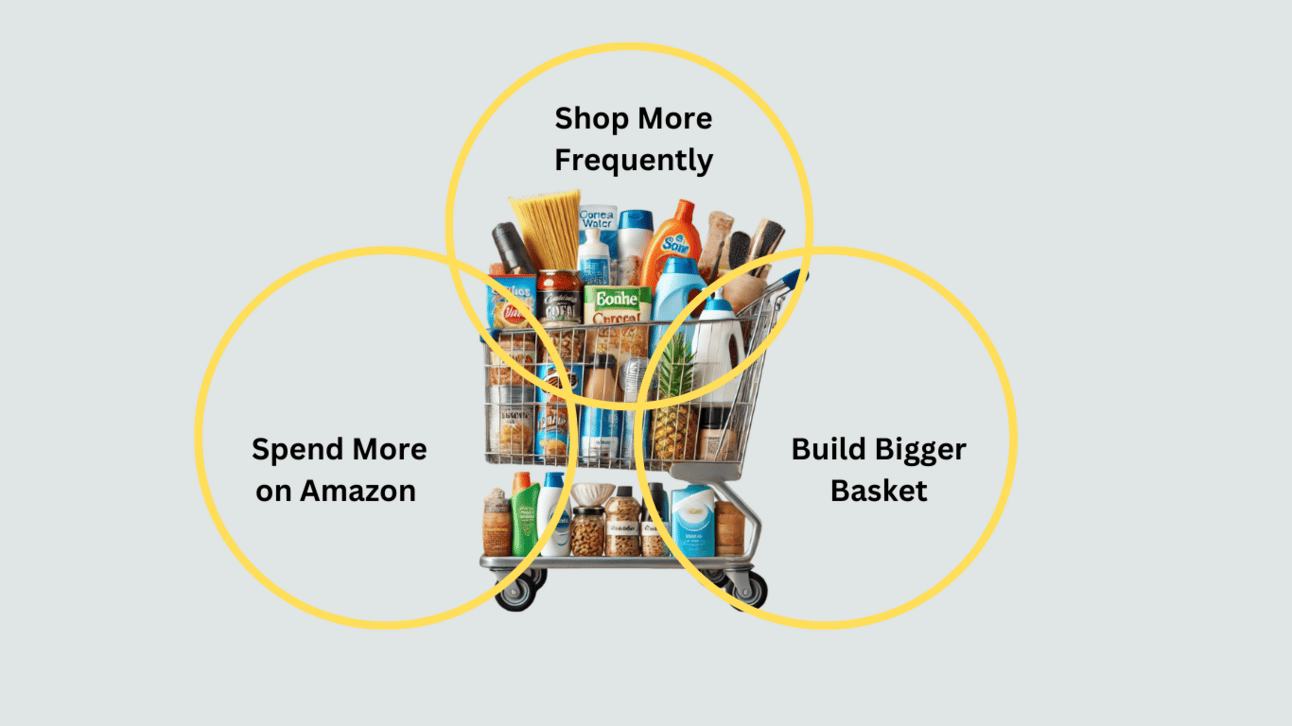
Amazon CEO: “Customers are enjoying even faster delivery speeds, which also helps drive strong growth in items like everyday essentials. This includes items like health, beauty, and personal care, as well as nonperishable grocery. “
He is talking about you!
Your products are the glue to how Amazon sees bring customers back, to buy more.
While selling, and selling profitably CPG on Amazon can be very challenging, I strongly believe there has been no better time.
It’s not only about sales (btw, Amazon accounts for 40% of online grocery sales in the US). But about meeting customers where they are, diversifying from retail, building ecommerce muscle.
I write this newsletter with the main mission of helping brands to get Amazon to serve their business. Rather than the other way around, which unfortunately I see a lot of.
And if I can help you through working directly with you and your brand to figure out how to grow profitably your Amazon business - then reply and let me know.
Onward and upward.
Saludos,
Irina