- Amazon CPG Digest
- Posts
- Demarcation lines of success
Demarcation lines of success

Irina Balyurko
December 21, 2025
Last weekend, we were fortunate to see a performance of The Nutcracker by the Russian National Ballet in a nearby city. Even my 13-year-old footballer, surprisingly, tolerated it. When you spend time in a "big city" within a country that still has a growing middle class, seeing bifurcation between have and have nots, luxury and poverty is easy.
In Mexico City you can go from the glitz of Polanco and Paseo Reforma to neighborhoods with informal economy of taco stands, tangled power lines, and street vendors in a short cab ride. Contrast lives side by side.
And I just couldn’t help but think: this is increasingly how Amazon feels.
Bifurcation and the 2%
Marketplace Pulse recent article had a great phrase: Amazon is moving from entrepreneurial experimentation to ecommerce infrastructure.
This shift has been happening through the years, and accelerated in 2025. We’ve seen closures of physical Amazon Fresh locations, further fee granularity, and the introduction of charges for software providers accessing the API. Amazon’s first-party retail business now represents roughly 40% of its total activity, down from prior years, as the company continues reducing direct retail exposure and leaning into its role as a logistics, advertising, and services platform. Amazon optimizes for monetization and efficiency.
To win on Amazon, brands must understand where Amazon itself is headed, because the platform increasingly rewards sellers who align with what Amazon values: predictability, operational discipline, and scale efficiency.
The marketplace has also stopped expanding through sheer growth. While Amazon still welcomes thousands of new sellers each month, the number of active U.S. sellers has hovered around 1.1 million since 2019. We can deduce consistent churn through these numbers. Also, roughly 2% of sellers now generate over 50% of total marketplace revenue. That’s quite a power-law distribution. And it’s not accidental. It reflects Amazon’s structural preference for sellers that can operate at scale, absorb complexity, and align with the platform’s economic incentives. The result is a clear demarcation between brands that adapt to Amazon as infrastructure and those that continue to approach it as an experimental sales channel.
In 2015, year I got into the Amazon space you could be an unknown, or no brand, not skilled in Amazon or ecommerce, get easily approved selling on Amazon, and start grow and make sales.
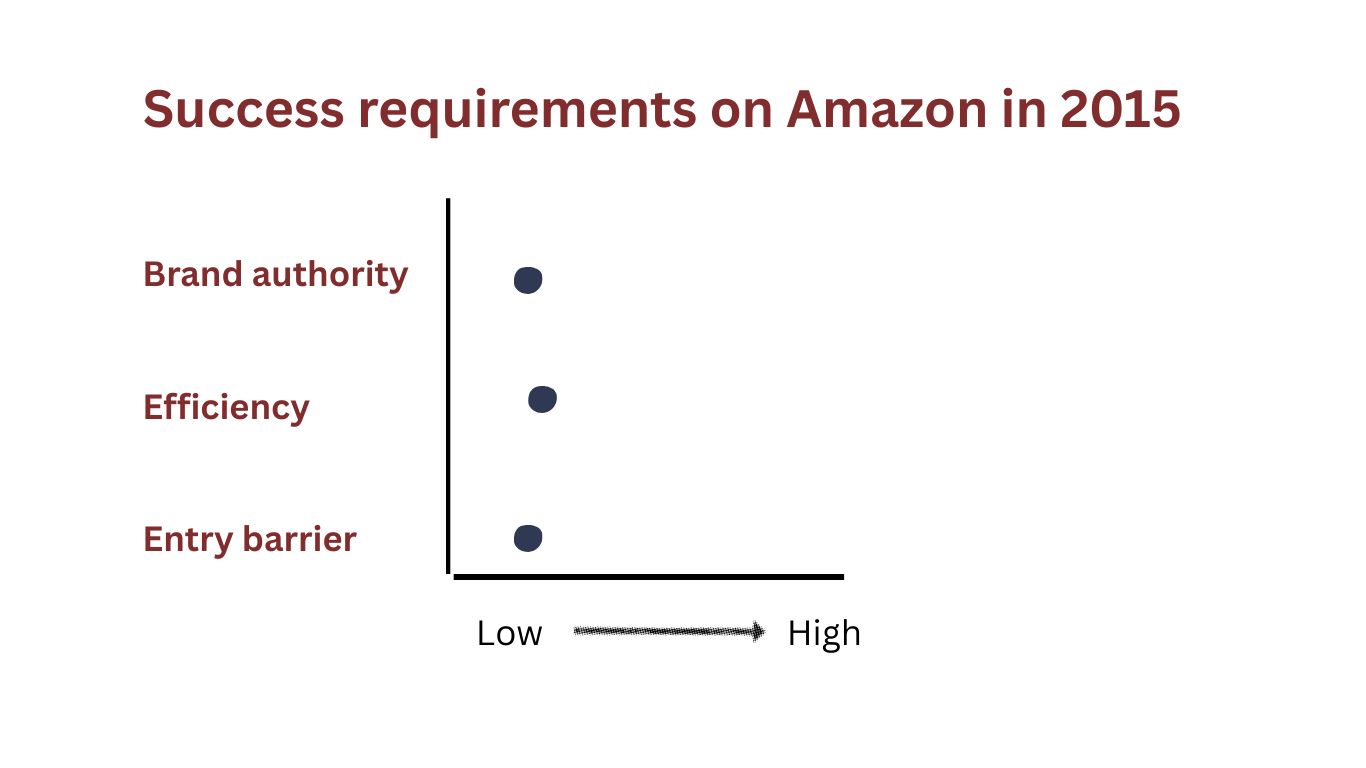
Here is how I see it in 2025.

The Balance between profit and top line sales
As Amazon matures into a service provider, its incentives are straightforward: fees.
It’s been a while since I heard ‘we want to scale from 0 to a million in one year’ to my ‘whats your Amazon goal’ question. Now I hear some variation of a sustainable growth, i.e as long as there is visible, conistent growth, without killing margins, many brands consider that a success on Amazon.
In 2026, average FBA fees will rise by approximately $0.08 per unit. Advertising costs (both on and off Amazon) continue to climb. Then we have external macro events like inflation, supply chain volatility, and tighter capital markets.
Winning lene of 2026 is shaping up with Amazon treated as a transactional B2C platform, allowing brands to leverage the infrastructure for its scale while protecting their margins through brand authority built outside the algorithm.
Efficiency
Here efficiency I don’t mean ‘doing more with less’ (that I view as a strategic function). But it’s about speed and accuracy of execution: addressing notifications, fixing catalog issues, agility in replenishments, all very much operational.
That is due to Amazon’s platform becoming more complicated and less forgiving.
At this point I see an expert catalog and Amazon operational manager who is persistent and quick in issue resolution just as valuable as a PPC manager who can drive a profitable ROAS.
Brand Authority
Building brand authority has become an increasingly capital-intensive endeavor as CPCs rise across all traditional digital marketing channels. At the same time, AI has collapsed the cost and speed of content production. Platforms like Meta are moving toward goal-based advertising models where you specify intent and audience, and the system handles creative generation and optimization. This will almost certainly push CPCs higher as competition intensifies.
Brands that “grew up” outside Amazon (through retail, DTC, community-driven channels, MLMs, etc.) enter the marketplace with a meaningful advantage, they arrive with pre-existing awareness.
For younger brands, the challenge is: how to build brand authority without becoming overly dependent on Amazon’s paid marketing. That likely means investing in trust, differentiation, and audience relationships outside the marketplace, with Amazon as the primary transaction engine.
Trust
Content creation has officially gained AI wheels. Tools like Nana Banana Pro and Amazon’s internal AI image generators are already delivering strong CTRs, they are very realistic, and they help collapse the time it takes to push content out.
With things like AI Instagram influencer who gained hundred of thousand of followers before followers learned it was not a real person happening now more and more, it also means our trust as consumers and followers, as audience is collapsing as well. But that also means trust becomes more valuable and an unfair advantage.
I expect a bifurcation here as well. Brands that lean into unfiltered, human, imperfect content - real people on camera, authentic messaging, less polish, spontaneity- will stand out. For established brands, this may require a shift in marketing lens, but for younger brands it can be MO of core marketing.
My view: trust-driven content must remain in-house. Paid creative and experimentation can scale with AI. Both can coexist, but they should not be confused.
Agile Support Structures
Traditional agency model is not dead, but highly compromised and not as necessary anymore.
As execution becomes easier through automation and AI, the real value shifts toward judgment, prioritization, curation, and interpretation. And let’s be honest: any gains in innovation or efficiency gained from AI would be retained by the agency for their own profit margins rather than being passed down to the clients.
An agile model looks different: strategy, resource allocation, management are owned internally or close to leadership, while execution handled by a flexible network of specialists (paid advertising, channel specific operations, design). Expertise, speed, and adaptability now matter more than headcount or long retainers. You still need a conductor, but not one permanently attached to a full orchestra of execution specialists. For SMBs, this flexible, modular support model is increasingly the one that makes the most sense, and, I believe, the model of the future.
Who is positioned well for 2026
Looking ahead, I see a few clear profiles of brands positioned to win:
Brands that combine external brand authority with operational channel efficiency - strong demand and brand awareness, paired with strong Amazon execution.
Businesses that want Amazon to grow but don’t rely on it for brand building because they already have working channels elsewhere.
B2B-heavy or enterprise brands using Amazon primarily as a transactional B2C outlet, where operational excellence drives success.
Human-centric content creators - brands with founder-led, influencer-like, storytelling marketing. They create a sense of trust that automated competitors cannot replicate. Amazon serves mainly as a transactional platform, but with more sales and ranking organic discovery comes as well
Saludos,
Irina
If you need help with your 2026 Amazon strategy and management, reach out for help.