- Amazon CPG Digest
- Posts
- How to manage your Amazon product mix for more sales and profitability
How to manage your Amazon product mix for more sales and profitability

Irina Balyurko
March 02, 2025
Over the years of working with brands on Amazon strategy, I’ve developed a set of core principles that help businesses maximize sales and profitability while maintaining control over pricing, brand perception, and long-term sustainability. One of these strategic areas that I think gets less focus than it deserves is the product mix. Not products themselves, but the product portfolio management.
Just like an investment portfolio of stocks, bonds, and other financial instruments, products your brand sells on Amazon is a portfolio of assets, risks, better or worse performers. So a lot of success on Amazon is about curating the right mix of products and managing them intelligently.
Below are the few guiding principles I apply in almost every case when advising brands on their Amazon product mix strategy.
1. 80/20 Rule for Launch and Growth
Amazon is not the place to experiment with every SKU in your catalog. When launching on Amazon I typically recommend starting with the 80/20 rule—launching with the 20% of products that generate 80% of your revenue elsewhere (exception being B2B products that need to be adapted to Amazon B2C platform).
Launching with 5-10 SKUs allows these core SKUs establish velocity, avoid creating operational complexity, or tying up cash flow in slow-moving inventory
2. Leverage Amazon-Exclusive Product Offers
One of the most effective levers a brand can pull is the Amazon-exclusive SKU strategy. These are products or bundles that exist only on Amazon and serve primary purposes of:
Protect pricing & MAP policies - By offering unique versions, you eliminate direct price comparisons with your retailers, thus protecting those relationships
Prevent unauthorized sellers - A differentiated Amazon SKU makes it harder for resellers to piggy back on your listings.
Optimize for e-commerce logistics: Packaging can be tailored for Amazon, reducing fulfillment costs and increasing efficiency
Protect price parity pressure - Amazon wants to be the lowest price platform, and often suppresses Buy Box if your product is more expensive on amazon than on other channels. Amazon exclusive SKUs lowers the pressure of price parity
Many successful brands create Amazon-only bundles or multipacks to protect margins while maximizing Average Order Value (AOV). For example, the most common approach for CPG brand that sells single-unit products in retail is to offer a 3-packs or variety packs, or a set of complementary products (shampoo and conditioner) exclusively on Amazon. This avoids direct competition with your retail partners while allowing for better unit economics.
Creating an Amazon exclusive SKU is an investment, but, when such decisions are based on data, it’s a worthwhile investment
3. Removing emotional bias
This point is especially tickle-ish for brand owners that started a business because they created a product they saw a need in, or are passionate about. Founders and product developers at times have personal attachment to certain SKUs.
If you recognize yourself in that, best is to bring an outside, analytical and dispassionate business mindd yang to your ying.
4. Lifecycle stages of products
Not all products have the same role in your Amazon strategy. Typically products go through four key lifecycle stages, and understanding this is critical to managing inventory, ad spend, and long-term profitability:
Introduction – Testing demand with limited launches or DTC experiments.
Growth – Scaling successful products, expanding distribution, and optimizing supply chains.
Maturity – Maximizing efficiency through SKU rationalization and bundling.
Sunsetting – Retiring underperforming SKUs through discounting, phased withdrawals, or rebranding.
5. Traffic and Conversion Matrix
Sales is really about bringing enough people to your product, and getting them to buy. In ecommerce words of choice are traffic and conversion.
I use this traffic and conversion matrix to help brands decide how to allocate resources, advertising, and optimization efforts.
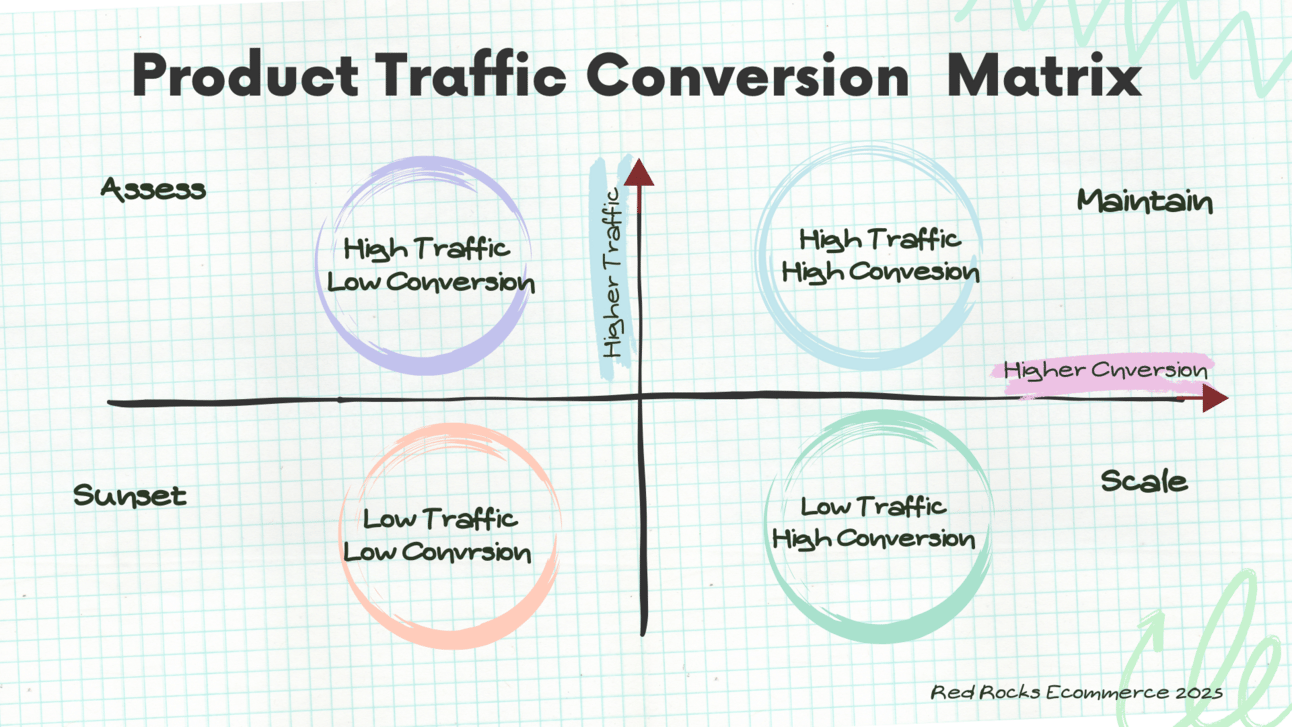
High Traffic / Low Conversion → ASSESS (Missed opportunity: Pricing, images, messaging/education, reviews)
High Traffic / High Conversion → MAINTAIN (Winning SKU: Keep optimizing, don’t over-invest, don’t get complacent)
Low Traffic / High Conversion → SCALE (Hidden opportunity: Invest in ads and visibility)
Low Traffic / Low Conversion → SUNSET (Underperformer: Consider discontinuing or repositioning)
6. Data Points That Matter for Product Decisions
Amazon is a data-rich platform, and data points can be noisy and overwhelming. Here are some data angles to assess SKUs performance:
Sales Velocity
Profitability & Cost Metrics
Traffic & Conversion Metrics
Advertising & Marketing Metrics
Customer Experience & Retention Metrics
Inventory & Supply Chain Metrics
7. The Dynamic Nature of Pricing
Your MSRP may be set elsewhere, but Amazon pricing is dynamic—requiring constant adjustments based on discounts, promotions, competitor pricing, and demand shifts (dynamic repricing), much like airlines and hotels. Price parity also matters, meaning your Amazon price should match or beat other channels, making Amazon-exclusive SKUs a valuable tool for maintaining control.
Beyond parity, pricing influences conversions in search results, where customers compare alternatives instantly. Psychological pricing—especially for bundles and multipacks—can enhance perceived value and drive higher sales. All in all, pricing can be tricky, but it is a strategic lever to be actively optimized, and not viewed as a static input.
For any brand serious about Amazon as a sales channel,product mix is more, and bigger, than just “what should be list?”. In the conclusion I want to leave you with few questions:
Which SKUs drive the most value?
Which SKUs should we focus more, and which to cut back?
How do we protect, and improve our pricing and profitability?
Saludos,
Irina