- Amazon CPG Digest
- Posts
- Let's talk about pricing on Amazon
Let's talk about pricing on Amazon

Irina Balyurko
December 07, 2025
Before we go into the topic, a quick reminder: This Sunday, December 7th, is the last day to book a 60-Minute Deep-Dive Consulting Session at the Cyber Monday price. You set the agenda - on anything from sales growth, to profitability, to 2026 projections, etc - and I bring the direct analysis to help you walk out with a path forward. Book your session here.
Pricing on Amazon
There is a story of the Symplegades (Clashing Rocks) in Greek mythology. The Symplegades were two cliffs at the entrance of the Black Sea that clashed together whenever a vessel went through. They crushed many ships, with remaining timbers scattered by the sea or destroyed by flames, serving as reminders of the dangers and the no-win scenario for any ship that attempted to go through.
Pricing on Amazon often feels to brands like trying to go through these rocks that can crush their ship (business) at any time.
Let’s first look at the actual rules of pricing on the Amazon marketplace, called the fair pricing policy. Highlights are mine.
Sellers are responsible for setting their own prices on Amazon stores. In our mission to be Earth's most customer-centric company, we strive to provide our customers with the largest selection, at the lowest price, and fastest delivery as sellers play an important role in achieving this mission.
Amazon regularly monitors the prices of items on our stores, including shipping costs, and compares them with other prices available to our customers. If we see pricing practices on a store offer that harms customer trust, Amazon can remove the Featured Offer, remove the offer, suspend the ship option, or in serious or repeated cases suspend or terminate selling privileges.
To interpret this in plain language: you as a brand have full rights to set your own prices, but prices will be monitored, compared to both on- and off-Amazon ‘other prices,’ with Amazon being a final judge of whether that price achieves full visibility for search and advertising.
In traditional market economy, pricing is a confluence of external and internal factors. The symbiotic relationship between supply and demand, customers and brands, means customers are able to find products at prices they are willing to pay, and businesses are able to make things at margins that support their growth

Pricing forces in a market economy
However, on the Amazon marketplace, Amazon inserts itself as a platform provider and a rule setter. Its core value is offering a wide range of products, at lowest prices, with fastest delivery. So when it comes to pricing, the big picture looks more like this:

Pricing forces on Amazon marketplace
On Amazon, those forces are filtered through an algorithmic layer that interprets your price in the context of historical patterns, cross-channel comparisons, competitor behavior, and Amazon’s own internal benchmarks.
In practice, customers are subconsciously trained by Amazon’s signals -badges, suppression warnings, comparison charts, strikethrough formatting - to treat them as authoritative judgments on whether your price makes sense. If Amazon suppresses a deal because a lower price existed two months ago, or flags your offer due to a cheaper price on another site, consumers interpret that as the product being overpriced or inconsistent. The algorithm’s perception becomes the consumer’s perception. This is why pricing on Amazon isn’t simply about the price you want, but also what Amazon’s system commands and pushes brands to adapt.
Important to talk about resellers as well. Resellers and distributors become part of that pricing, and their actions immediately become part of Amazon’s “price history”. And Amazon does not distinguish intent. A reseller selling through inventory of you poduct is treated the same way as a strategic price drop from the brand.
Then pricing monitoring extend to other channels as well. If MAP is broken on other channels (iHerb, Walmart.com, Target.com, Faire, etc.) the fallout often hits Amazon hardest because Amazon proactively ingests cross-channel pricing, and low prices become a benchmark for the near future. This is why pricing on Amazon isn’t an isolated Amazon problem, it’s an ecosystem problem, with Amazon acting as the amplifier.
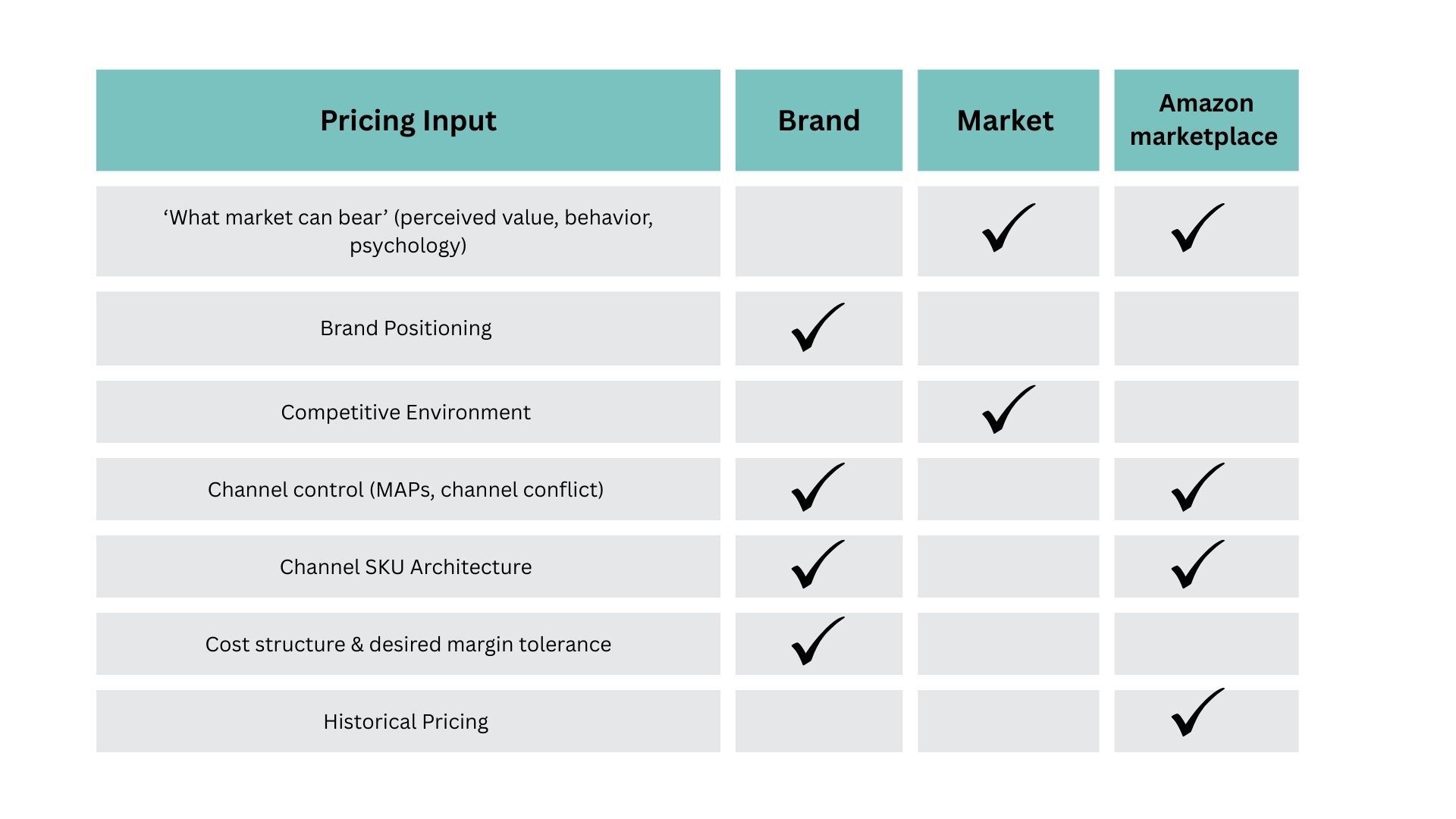
Here is how I see pricing inputs must be viewed on Amazon, so you as a business owner or CxO can see the big picture of where these factors originate from and how they intersect with your strategy:
Back to the clashing rocks story, if you are curious how it all ended: Eventually the Symplegades were outsmarted by the Argonauts. Jason, a Greek hero and a leader of the Argonauts, let a dove fly between the rocks to see exactly how fast they would have to row to beat the rocks; the dove lost only its tail feathers. The Argonauts rowed mightily to get through and lost only part of the stern ornament. After that, the Symplegades stopped moving permanently.
Setting pricing on Amazon, being able to control it, is an act of not only business soundness, but also understanding Amazon platform dynamics, and realizing Amazon doesn’t exist in isolation, but interacts with other channels.
Saludos,
Irina
If you need help with your 2026 Amazon strategy and management, reach out for help.